

 English
 русский
 عربى

Product Consultation
Your email address will not be published. Required fields are marked *
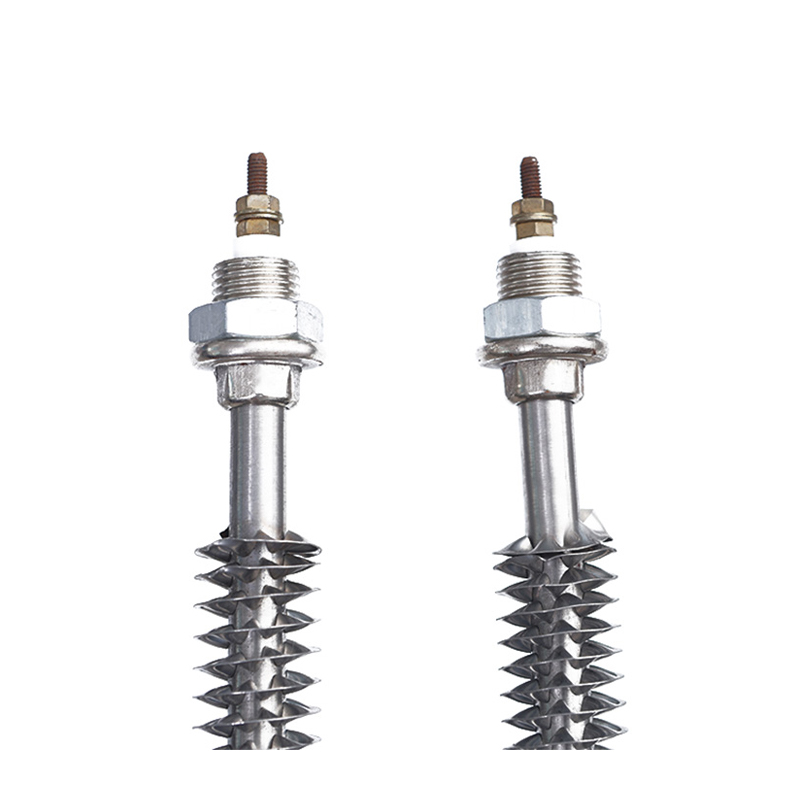
A finned heating element exists for one reason: to transfer more heat into moving air without pushing the sheath temperature past its material limit. In a duct heater carrying a 150 kW air heating load, a bare tubular bundle can need more than twice the heated length of a finned bundle for the same outlet temperature. Fins multiply the external surface area by roughly 3.4 to 7.8 times, depending on fin pitch, fin height, and whether the fins are wound, crimped, or brazed.
The practical effect is lower watt density on the sheath, lower metal temperature, and a longer service life in the same airflow. Most industrial finned heating elements are resistance coils inside stainless steel or Incoloy tubes, with carbon steel, stainless steel, or aluminum fins attached to the outside. They appear in duct heaters, ovens, drying tunnels, conveyor air knives, and recirculating air systems where the air side is the bottleneck.
Watt density is the rated wattage divided by the heated sheath area. A finned element spreads that wattage over the tube and fin surface, which is why it can run cooler than a bare tube at the same total power.
The difference is surface loading. Adding fins increases the area available for convection, so the same heat output can be achieved at a lower sheath temperature. Lower sheath temperature slows oxidation, reduces thermal stress, and protects the resistance wire from accelerated corrosion.
This comparison does not mean a finned element is always the better choice. In dusty paint ovens or lint-heavy textile dryers, fins can become blocked. A blocked finned element then behaves like a bare tube running at a much higher watt density, which accelerates burnout. The airflow path, filter setup, and maintenance access need to be part of the design.
In stationary air, do not run a finned heating element at the same watt density used in a 5 m/s duct. With no convection, the fins act as insulation, and the element fails through sheath oxidation long before the rated heater life is reached.
For air heating, the first material decision is the sheath, not the fin. The sheath must survive the highest surface temperature the element can reach under normal flow and under a blocked-flow failure, because the fin only has to conduct heat into the air.
304 stainless steel is the default for clean air up to 600 degrees C. 321 stainless steel adds titanium for better creep resistance. Incoloy 800 has stronger high-temperature oxidation resistance and is common in ovens. 310S stainless steel handles the hottest duct temperatures but costs more and is harder to form into tight fin pitches.
| Sheath material | Max continuous air temperature (C) | Typical forced-air range (W/cm2) |
| 304 stainless steel | 600 | 2.0-3.5 |
| 321 stainless steel | 700 | 2.5-4.0 |
| Incoloy 800 | 800 | 3.0-5.0 |
| 310S stainless steel | 900 | 3.5-6.0 |
Tighter fin pitch increases the surface area multiplier, but it also raises pressure drop and creates narrow slots where dust can lodge. Below 5 mm pitch, the air film between fins starts to approach the boundary layer thickness at low velocity, and the extra area adds little heat transfer.
Rule of thumb: above 6 m/s duct velocity, the benefit of tighter fin pitch diminishes quickly. Always calculate pressure drop before choosing a pitch below 6 mm.
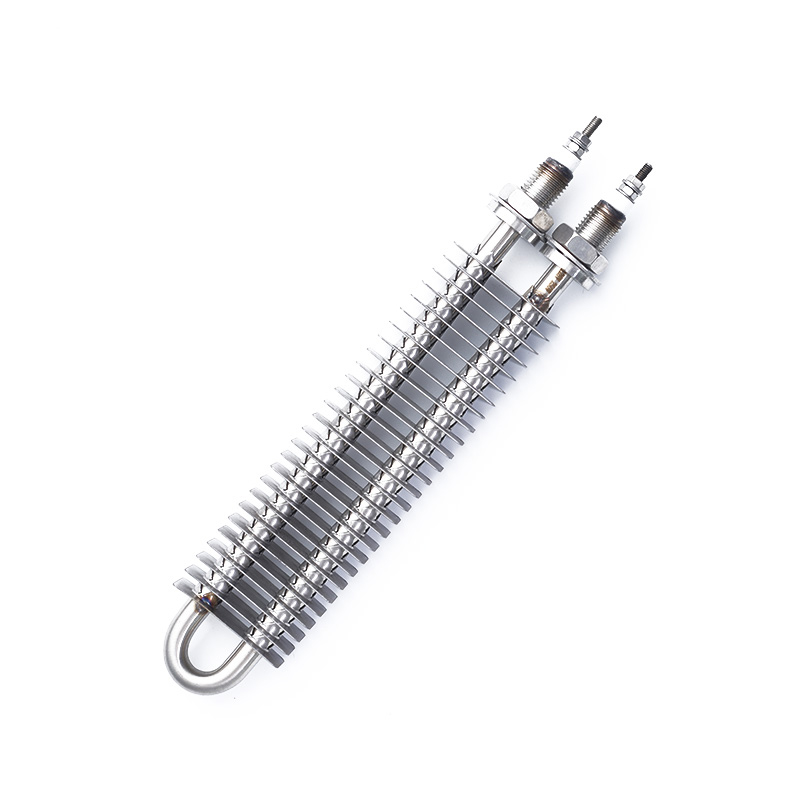
Shape is the second decision after material. An I-shaped finned element is the simplest through-wall design for horizontal airflow. It gives a straight heated length, predictable expansion, and easy replacement from the duct access panel.
 I-Shaped Finned Heating Tube for Horizontal AirflowThe I-shaped finned element is the simplest through-wall design, offering straight heated length, predictable expansion, and easy replacement, making it ideal for horizontal airflow in duct heaters.View Product →
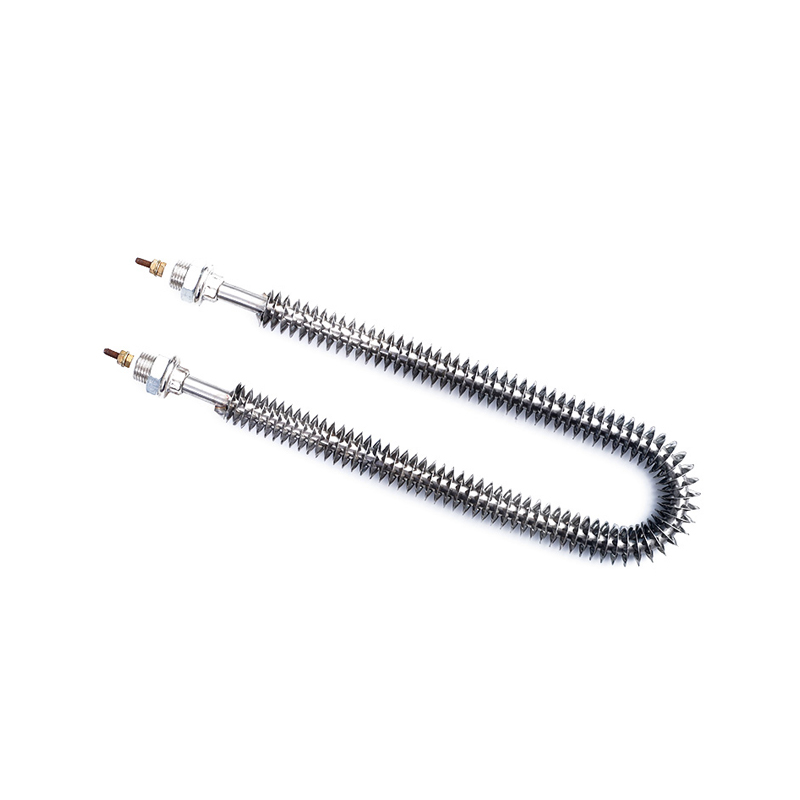
A U-shaped finned element gets more heated length into a short duct without adding extra end fittings. The return bend reduces the number of wall penetrations, which matters in pressurized or insulated housings.
 U-Shaped Finned Heating Tube for Short DuctsThe U-shaped finned element maximizes heated length in short ducts, reduces wall penetrations, and ensures even heat distribution, making it suitable for pressurized or insulated housings.View Product →
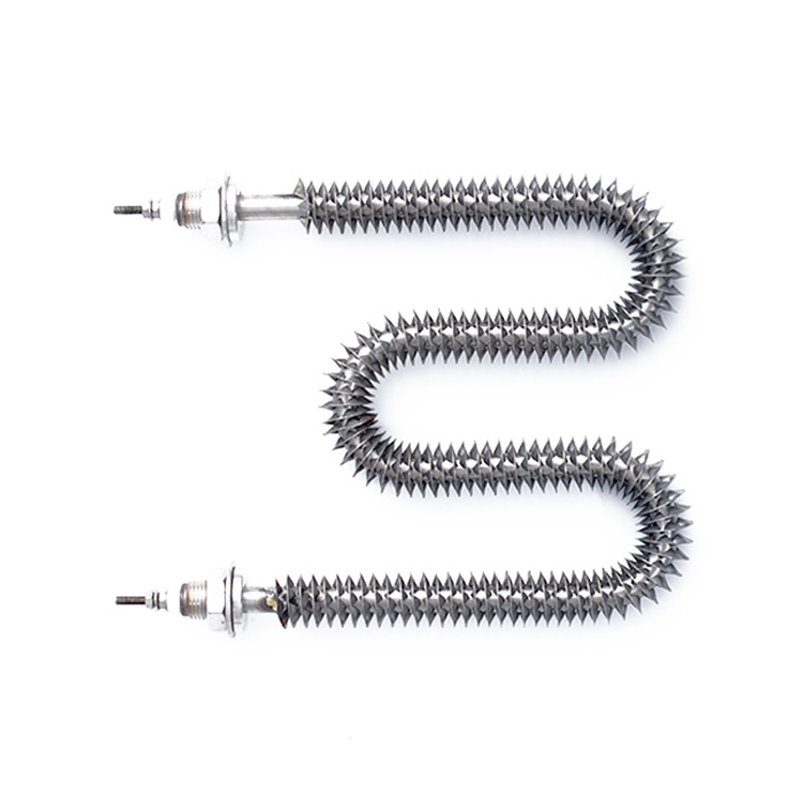
Square and O-shaped finned elements work in blower heater housings where the heating core must be compact. The continuous perimeter path delivers a high surface area inside a small casing profile.
 Square Finned Heating Tube for Compact CasingsThe square finned tube provides increased structural rigidity and a continuous perimeter path for high surface area in compact blower heater housings, ensuring efficient heat transfer and durability.View Product →
Xinghua Yading Electric Heating Element Co., Ltd. (Yading) builds these configurations as part of its finned air heating tube range. The choice is not purely geometric. In a vertical duct, U-shaped elements should be oriented with the open end down so condensation does not pool at the bend. In a horizontal oven, I-shaped elements mounted across the airflow create a uniform thermal curtain. Square and O-shapes are usually selected to maximize surface area inside a circular or square casing.
The same element can last twice as long in one orientation and burn out quickly in another. Mounting affects how condensate drains, how fins shed dust, and how evenly air reaches the heated surface. Review the mechanical layout before you confirm the heater drawing.
Leave 1.5 to 2 times the fin outside diameter between adjacent elements in an oven. That spacing balances heat transfer against shadowing and gives maintenance staff enough clearance for fin brushing.
The fastest way to get a reliable finned heating element is to specify it in the same order an engineer calculates it: air duty, surface loading, materials, geometry, electrical supply, and control.
Factories with a wide product range handle this process quickly. Yading's plant produces more than 500,000 heating elements per year and exports to more than 25 countries, which means the engineering review is built into every custom order as well as every standard unit. If you want the calculation checked before ordering, send the airflow worksheet to the engineering desk through the contact page.
Never specify a finned heating element without stating the minimum air velocity at the element surface. Low-flow lockouts, damper failures, and fan faults are the leading field causes of finned element burnout.
With clean air moving at 2 to 10 m/s, 2.0 to 6.0 W/cm2 is a practical range depending on sheath material and operating temperature. Below 1.0 W/cm2 the element is oversized; above 6.0 W/cm2 the sheath life starts to fall rapidly.
Not normally. In water or oil, fins trap scale, which acts as an insulator and creates local hot spots. An immersion heater with a smooth sheath or flanged design is a better choice for liquid duties.
Use 304 for clean dry air up to 600 degrees C. Use Incoloy 800 when the outlet air temperature exceeds 600 degrees C or when the heater cycles frequently. The sheath material, not the fin, sets the upper limit because the fins are cooled by the air stream.
Fin pitch determines surface area, pressure drop, and how easily the heater can be cleaned. A tight pitch can block quickly in air streams that contain fibers, oil mist, or conductive dust, and the blocked element will overheat the sheath. Choose a wider pitch for dirty air and rely on more surface length instead.
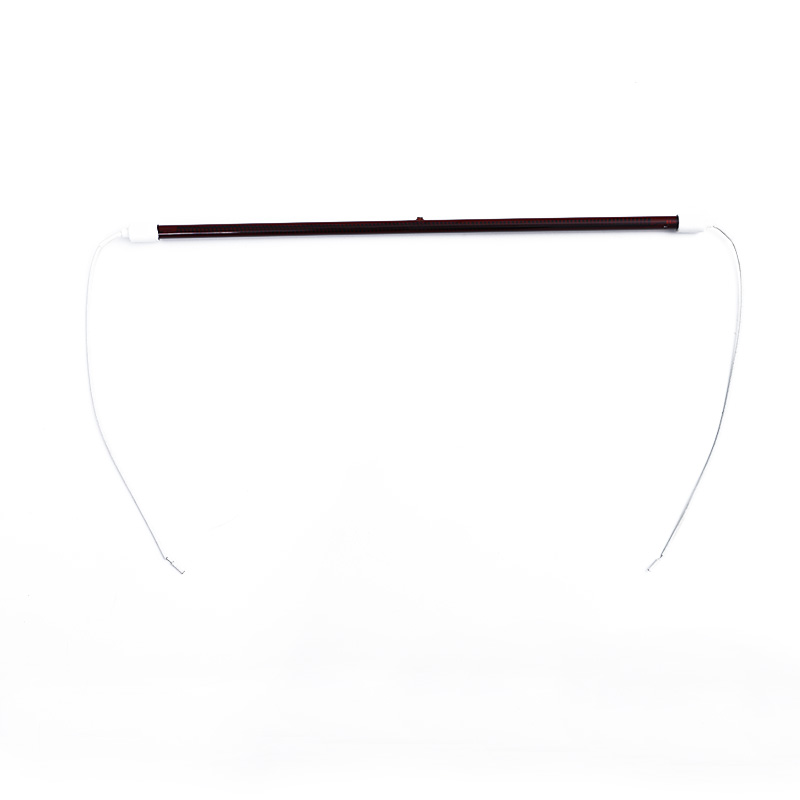
Electric Infrared Heater Tube: Selection, Wavelengths, and Efficiency Guide
Oct 21,2026
No previous article
Jan 01,1970Your email address will not be published. Required fields are marked *