

 English
 русский
 عربى
عربى
Product Consultation
Your email address will not be published. Required fields are marked *
Infrared heating differs fundamentally from convective and conductive heating in a way that most buyers don't immediately appreciate: infrared radiation transfers energy directly to the material being heated without needing to heat the surrounding air or a conductive medium first. The rate of energy transfer and the depth of penetration depend critically on the wavelength of the radiation emitted, and different materials absorb different wavelengths with vastly different efficiency. This means that choosing the right infrared heater for an application is not simply a matter of matching power output to heat load, but matching the emission wavelength to the absorption characteristics of the specific material being processed.
This guide covers the three main categories of infrared heaters, what determines their emission wavelength, how different materials respond to each wavelength band, and what this means for specification decisions in industrial and commercial applications.
All objects emit electromagnetic radiation as a function of their surface temperature — the hotter the surface, the shorter the peak emission wavelength and the greater the total radiated power. This relationship is described by Planck's law, and the simplified practical expression is Wien's displacement law: peak wavelength (µm) = 2898 / surface temperature (K). An element surface at 2500K (approximately 2227°C) emits peak radiation at about 1.2 µm (shortwave near-infrared); an element at 700K (approximately 427°C) emits peak radiation at about 4.1 µm (mid-infrared); an element at 500K (approximately 227°C) emits at about 5.8 µm (far-infrared).
The key point is that the infrared heater element temperature directly controls the emission wavelength. A hotter element emits shorter wavelength radiation; a cooler element emits longer wavelength radiation. The element temperature is in turn controlled by the watt density, sheath material, and operating conditions — so when a buyer selects "shortwave" or "longwave" infrared, they are implicitly specifying the element temperature and therefore the emitter design.
The absorbed fraction of incident infrared radiation depends on the absorptivity of the material at the incident wavelength. Some materials — water, polar polymers, many organic coatings — absorb long-wave infrared very efficiently. Some materials — glass, some ceramics, quartz — are transparent to near-infrared and become opaque at longer wavelengths. Carbon-based materials and some metals absorb short-wave infrared well. Matching the emission wavelength to the material's absorption peak produces efficient, rapid heating; mismatching can result in the radiation passing through the material untouched or being reflected from the surface.
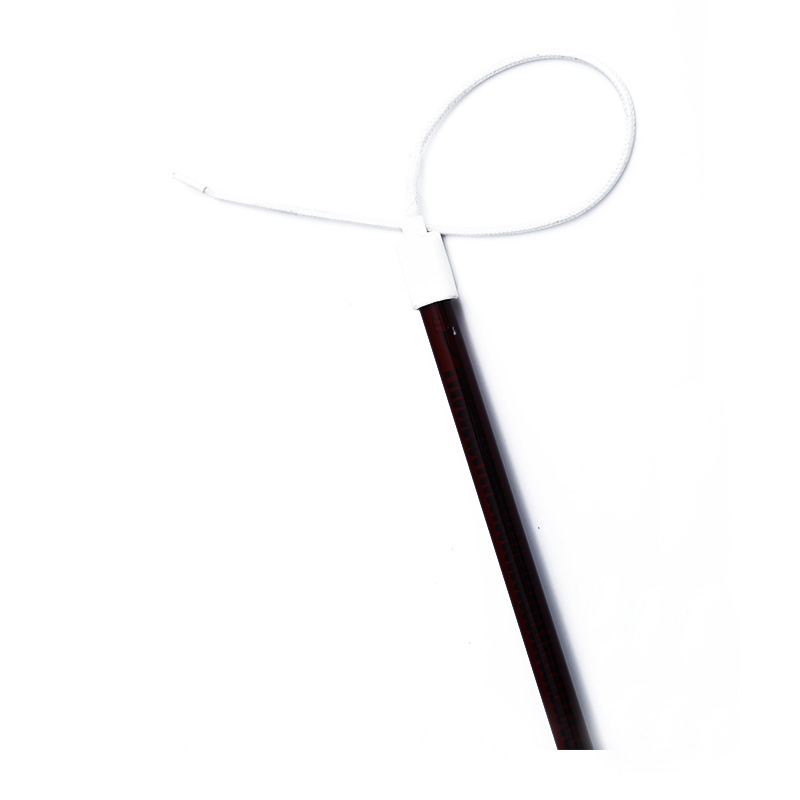
Short-wave infrared heaters — also called near-infrared or NIR heaters — operate at very high element temperatures, typically 2000–2500°C for tungsten filament types and 1200–1800°C for other metallic element types. At these temperatures, the emission peak is in the 1–2 µm wavelength range. Short-wave heaters reach full operating temperature in seconds (tungsten halogen types in 1–2 seconds), making them suitable for applications requiring rapid on/off cycling and precise thermal control.
Short-wave infrared can penetrate certain materials to some depth rather than being absorbed entirely at the surface, which is useful for through-heating applications. It is also reflected by most metallic surfaces and transparent through certain materials — this penetration and transmission behavior makes short wave useful for selective heating where only certain components in a multi-material assembly should be heated, or where the radiation must pass through a transparent cover material to heat the substrate underneath.
The very high element temperature of short-wave heaters requires appropriate housing and quartz glass tube envelopes for the element (to contain the atmosphere around the filament and protect the filament from oxidation). Short-wave heaters are more mechanically delicate than medium or long-wave designs because the high-temperature filament is sensitive to thermal shock and vibration.
Common short-wave infrared applications include: drying and curing of surface coatings and paints on metal substrates; pre-heating of metal sheets before forming; food processing (browning and surface caramelization where rapid surface heating without bulk cooking is desired); and medical/therapeutic applications where rapid radiant heat to tissue depth is required.
Medium wave infrared heaters operate at element temperatures of approximately 800–1200°C, producing peak emission in the 2–4 µm wavelength range. This temperature range is achievable with resistance alloy heating elements (nickel-chromium or iron-chromium alloys) in metallic sheath tubes — the same basic construction used in cartridge heaters and air heating tubes, but optimized for radiant emission rather than conductive or convective heat transfer.
Medium wave emission overlaps with the absorption bands of many organic materials, polar solvents, and polymers. Water's primary infrared absorption band is centered at approximately 2.9 µm — firmly in the medium wave range — making medium wave heaters highly effective for drying water-based coatings, adhesives, and other aqueous materials. The 2–4 µm range also aligns with the absorption of many varnishes, resins, and organic functional groups, making medium wave heaters well-suited for curing processes in the coatings and composites industries.
Medium wave heaters warm up more slowly than short wave types (typically 30–90 seconds to reach operating temperature) but are more robust and less sensitive to mechanical disturbance. The metallic sheath construction provides better protection in contaminated or humid environments. For continuous industrial processes where the heater operates continuously rather than cycling rapidly, medium wave heaters offer a better combination of performance and durability than short wave alternatives.
Common medium wave infrared applications include: drying water-based inks, coatings, and adhesives; curing powder coatings and UV-activated resins; pre-heating of plastics for thermoforming; laminating processes; and textile drying and finishing.
Long wave or far-infrared heaters operate at lower element temperatures, typically 300–600°C, producing emission in the 4–10 µm wavelength range. At these temperatures, the emission spectrum shifts substantially toward longer wavelengths. Far-infrared emission corresponds to the thermal motion absorption bands of many organic materials and water in its liquid state, and also to the strong absorption of the most dense polymers and composites.
Long wave infrared is absorbed almost entirely at the surface of the most dense materials rather than penetrating to any depth — the energy is deposited in a very thin surface layer and conducts inward from there. This surface absorption characteristic makes long-wave heaters efficient for applications where only surface heating is required, or where the material to be heated is itself a good thermal conductor that rapidly distributes the surface-absorbed energy through the bulk.
Long wave heaters have the slowest warm-up time (minutes) and the lowest element temperature of the three categories, which has advantages: they are more robust, less prone to thermal shock failure, and produce lower intensity radiation that is safer in environments with combustible materials or where operator exposure is a concern. The lower element temperature also means longer element service life for equivalent usage cycles.
Common long-wave infrared applications include: space and comfort heating (the radiation wavelength is efficiently absorbed by human skin and tissue at the surface); drying of water-absorbing materials like paper, wood, and textiles; floor and panel heating systems; warming food display counters; and applications where gentle, diffuse radiant heat is preferable to intense localized heating.
| Property | Short Wave (NIR) | Medium Wave | Long Wave (Far IR) |
|---|---|---|---|
| Element temperature | 2000–2500°C (tungsten) or 1200–1800°C (metal) | 800–1200°C | 300–600°C |
| Peak emission wavelength | 0.8–2 µm | 2–4 µm | 4–10+ µm |
| Warm-up time | 1–5 seconds | 30–90 seconds | Minutes |
| Material penetration | Some penetration in specific materials | Limited surface penetration | Surface absorption only |
| Best for | Metal heating, paint curing on metal, food browning, rapid cycles | Water-based drying, polymer curing, powder coatings, and composites | Space heating, textile/paper drying, gentle surface warming |
| Element construction | Tungsten halogen lamp or quartz tube metallic element | Metal sheath resistance element | Ceramic, metal sheath, or panel emitter |
| Robustness | More fragile — high-temp filament sensitive to shock | Good — metallic sheath construction | Excellent — lower operating temperature |
| Water absorption efficiency | Moderate | Excellent — peak emission aligns with water absorption band | Good — absorbed by the liquid water surface |
| Transparent to glass/quartz | Yes — short wave passes through | Partially | No — absorbed by glass |
Within each wavelength category, infrared heaters are available in different element constructions that affect installation, durability, and emission characteristics.
Quartz tube infrared heaters enclose a tungsten or nickel-chrome resistance element inside a quartz glass tube, which is transparent to both shortwave and medium wave infrared. The quartz envelope allows the element to operate at high temperature while protecting it from contamination, and the enclosed atmosphere can be an inert gas or a vacuum to prevent oxidation. Quartz tubes are mechanically more fragile than metal-sheathed elements, but essential for tungsten filament elements.
Metal sheath infrared elements use the same MgO-insulated resistance wire construction as standard tubular heating elements, but are designed to operate in the medium-to-long wave range through controlled element temperature. They offer superior mechanical durability, IP-rated protection levels, and can be cleaned without damage — making them preferred for food processing, humid, or physically demanding environments. The sheath material (stainless steel, Incoloy, titanium) is selected for compatibility with the operating environment.
Ceramic infrared emitters use a resistive heating element embedded in or wound around a ceramic substrate. The ceramic surface radiates at longer wavelengths (far-infrared) efficiently and provides a large, diffuse emitting surface. Ceramic emitters are used for space heating, textile processing, and applications where the source of radiation should be physically robust and able to withstand mechanical contact.
Not necessarily, and potentially the opposite result. The efficiency of water evaporation from a coating depends on how much of the incident infrared radiation is absorbed by the water in the coating, and water's primary absorption band (around 2.9 µm) falls in the medium wave range. Short-wave radiation at 1–2 µm is absorbed by water at a lower efficiency than medium-wave radiation — more of the short-wave energy may be transmitted through the water layer and absorbed by the substrate rather than heating the water directly. For drying water-based coatings, medium wave heaters are specifically matched to water's absorption characteristics and typically produce faster, more energy-efficient drying than short wave heaters at the same power density. Short-wave heaters are more efficient for metal pre-heating and for applications where the target material absorbs short-wave radiation better than medium wave.
Distance affects both the irradiance (power per unit area) reaching the material and the uniformity of heating across the material surface. The inverse square law applies: doubling the distance from the heater to the material reduces the irradiance by a factor of four. Practical installation distances depend on the heater type and application: short-wave heaters with focused reflectors can be positioned further away (300–600mm) while maintaining high irradiance; diffuse medium wave panel heaters are typically installed closer (50–200mm) for effective heat delivery. For most industrial drying and curing applications, the optimal distance is determined by the required irradiance level and the available zone length — moving the heater closer increases irradiance and reduces process time, but creates less uniform heating across the width of the product. Zone uniformity is typically more critical in continuous web or conveyor processes than in static batch processes, and reflector geometry plays a significant role in achieving uniform irradiance distribution across the process zone.
In most drying applications, yes — infrared heaters deliver energy directly to the material being heated without the losses associated with heating the surrounding air and process enclosure. In a convection oven, a significant fraction of the input energy heats the oven structure and the circulating air, and is exhausted with the air when the oven is vented to remove evaporated solvent or water. In an infrared oven, the radiation is absorbed directly by the material's surface, and if the material is positioned efficiently relative to the emitters, the fraction of input energy that contributes to the drying process is higher. That said, the efficiency advantage of infrared depends on the specific material-wavelength match: poorly matched infrared (e.g., a wavelength band that the material reflects or transmits rather than absorbs) delivers less useful energy than convection heating that is independent of spectral absorption. The key is correct wavelength selection — which is why understanding the difference between short wave, medium wave, and long wave is not just a technical curiosity but a practical efficiency question with real implications for operating cost.
Infrared Heater | Air Heating Tube | Band Heater | Cartridge Heater | Immersion Heater | Contact Us
Watt Density in Electric Heating Elements: What It Is and How to Calculate the Right Value
Mar 15,2026
What makes special electric heating elements different from standard off-the-shelf heaters?
Apr 01,2026Your email address will not be published. Required fields are marked *