

 English
 русский
 عربى
عربى
Product Consultation
Your email address will not be published. Required fields are marked *
A vacuum sintering furnace holding at 1650°C is far outside the capability of a Type K thermocouple. Its nickel-chromium and nickel-aluminum alloy wires melt near 1400°C, and the output drifts well before that. A Type B thermocouple is built for that zone: it carries the highest continuous temperature rating of any standard thermocouple, 1700°C, with short-term capability to 1820°C, and its two platinum-rhodium legs resist the grain growth that ends base-metal sensors early.
A Type B thermocouple is a noble-metal temperature sensor defined by its material pair: a positive leg of platinum-30% rhodium and a negative leg of platinum-6% rhodium, standardized under IEC 60584 and ASTM E230. It produces a DC voltage through the Seebeck effect; as the measuring junction heats, the difference between the two alloy legs generates an EMF that instruments convert into a temperature reading.
Construction is straightforward: two wires are welded at the measuring junction, threaded through a two-bore high-purity alumina insulator, and protected by a metal or ceramic sheath. The junction can be exposed for fast gas measurement, grounded for moderate response, or ungrounded for electrical isolation. The output follows a non-linear curve:
The distinctive feature is the flat region at the low end: between 0°C and 42°C, the output stays under 3 µV.
Use a Type B thermocouple from 600°C to 1700°C for continuous service, with short excursions to 1800-1820°C acceptable. Below 600°C, the output is so small that measurement uncertainty rises quickly; above 1700°C, rhodium migration and grain growth shorten wire life.
Approximate EMF values from the standard Type B reference table, junction at 0°C.
Accuracy depends on grade. Standard limits of error are commonly quoted as ±0.5% of the measured temperature; special grade tightens the tolerance to ±0.25% of reading. For furnace qualification and calibration work, specifying special grade removes most of the sensor uncertainty from the measurement chain.
Type B earns its place wherever a process runs above 1400°C, because it outlasts every base-metal thermocouple at that level. Its limitations are low output at lower temperatures and a material cost several times higher than Type N or K.
Type B is the high-temperature specialist within the platinum-rhodium family. Types R and S deliver higher sensitivity through the 0-1400°C range, but their pure platinum legs cap the useful limit near 1600°C and require cold junction compensation.
| Property | Type B | Type R | Type S |
| Positive leg | Pt-30%Rh | Pt-13%Rh | Pt-10%Rh |
| Negative leg | Pt-6%Rh | Pure platinum | Pure platinum |
| Continuous maximum | 1700°C | 1400°C | 1400°C |
| Short-term maximum | 1820°C | 1600°C | 1600°C |
| EMF at 1000°C | 4.83 mV | 10.51 mV | 9.59 mV |
| Cold junction compensation | Not required below 50°C | Required | Required |
| Best fit | Above 1400°C | 0-1400°C high accuracy | 0-1400°C calibration |
If the sensor lives most of its life above 1400°C, Type B gives the longest service life and the simplest wiring. If the process cycles between 200°C and 1300°C, Type R or S provides roughly double the output, which translates into better resolution.
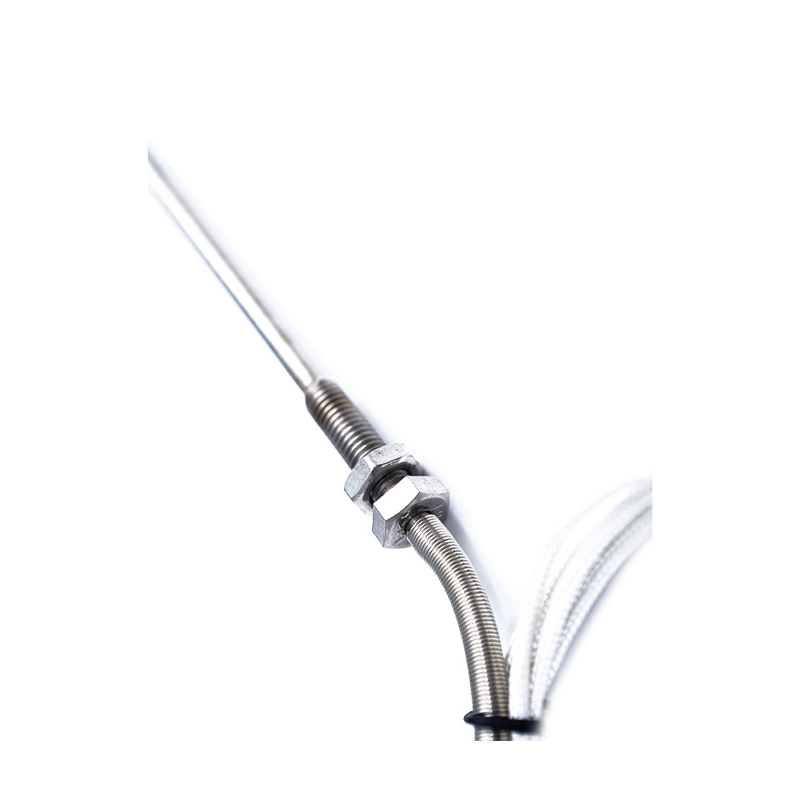 Platinum-Rhodium Thermocouple Types S, R, and B for High TemperaturesThe Pt-Rh thermocouple offers Types S, R, and B for high-temperature measurement up to 1800°C, with Type B best for sustained temperatures above 1400°C.View Product →
Specify Type B only when the process demands it: sustained temperatures above 1400°C. Then match sheath, insulation, and mounting to the atmosphere, because contamination, not heat, is the usual cause of premature failure.
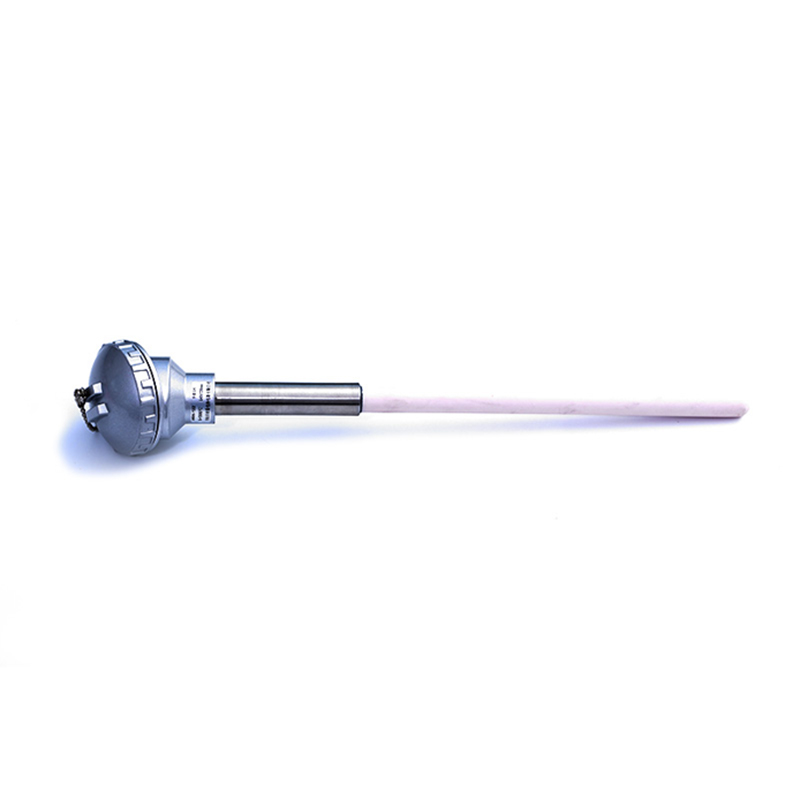 Base-Metal Thermocouple Types K, E, J, T, N for Cost-Effective RangeOffers K, E, J, T, and N thermocouples covering -200°C to 1300°C, suitable for furnace points below 1000°C with higher output and adequate accuracy at lower cost.View Product →
For measurement points below 1000°C on the same furnace, a base-metal thermocouple keeps costs low: the K/E/J/T/N line covers that range with far higher output and adequate accuracy.
Type B thermocouples are the default choice in processes where base-metal types fail within days and where R/S types cannot reach the required temperature. Four use cases stand out: glass, vacuum furnaces, heat treatment, and calibration.
The same factory's engineering team can size a Type B assembly for a specific furnace: immersion length, sheath material, junction type, and accuracy grade.
No. Between 0°C and 42°C the output is effectively zero, and sensitivity at 600°C is only about 5-6 µV/°C. Below roughly 600°C, a Type K, N, or J thermocouple gives better resolution at a fraction of the cost.
No. The EMF generated between 0°C and 42°C is less than 3 µV, below the zero offset of most industrial instruments. That is why isothermal terminal blocks and ice-bath references are unnecessary with Type B.
1700°C continuous, with short-term excursions to 1820°C. Service life shortens quickly above 1700°C because rhodium migrates and grain growth accelerates in the wire.
Yes, with the correct sheath. Bare platinum-rhodium wires are damaged by metal vapors; in vacuum use molybdenum or tantalum protection, and in carburizing or hydrogen atmospheres use a sealed alumina protection tube.
Air Heating Tube Manufacturer | 30 Years Custom Electric Heating Elements
Sep 02,2026
No previous article
Jan 01,1970Your email address will not be published. Required fields are marked *