

 English
 русский
 عربى
عربى
Product Consultation
Your email address will not be published. Required fields are marked *
When a 1200 W band heater on an extruder barrel shorts out after eleven weeks of service, the root cause is almost never the brand. It is the specification: mica insulation running at 38 W/in² against a barrel surface above 380°C exceeds both the material's temperature ceiling and its safe watt density. Replacing that zone with a ceramic band heater removes both failure triggers at once, because ceramic insulation carries higher watt density and runs continuously at up to 648°C (1200°F).
This guide covers what sits inside a ceramic band heater, how it compares with mica on the limits that decide service life, and a five-check ordering routine that prevents the most common selection errors. The goal is a heater order that survives the production campaign rather than becoming a recurring spare-parts line item.
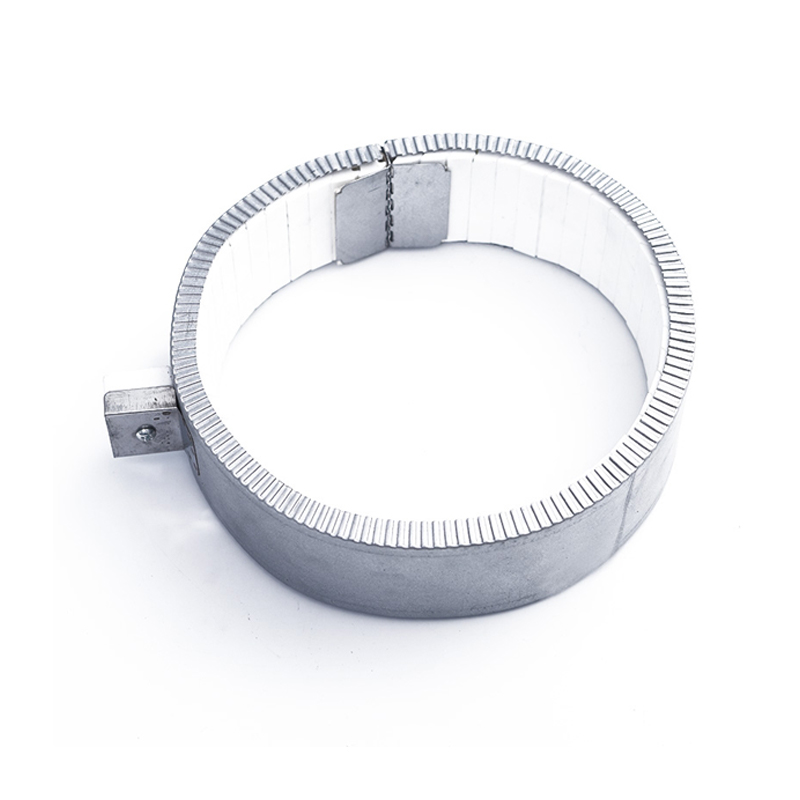
A ceramic band heater is a cylindrical clamp-on heater whose resistance wire is insulated by interlocked ceramic segments instead of mica sheet, which raises the continuous operating limit to 648°C (1200°F).
Inside a stainless steel sheath, a zigzag nickel-chromium resistance wire is embedded in high-purity ceramic segments. Those segments provide electrical isolation and a conductive thermal path, so heat transfers into the barrel wall by conduction rather than radiating across an air gap. A steel tension band clamps the assembly around the barrel, and the clamping screws or toggle levers allow replacement without cutting wires.
Optional construction details change the service profile. A built-in thermocouple shortens the distance between the sensor and the element and tightens PID control on fast-cycling zones. Sealed terminal boxes add protection where the machine frame is washed down, and a ventilated jacket can reduce heat loss from the outer surface.
Definition: a ceramic band heater is a clamping surface heater whose resistance element is insulated by compacted ceramic segments, rated for continuous operation up to 648°C (1200°F) and typically available at watt densities above 40 W/in².
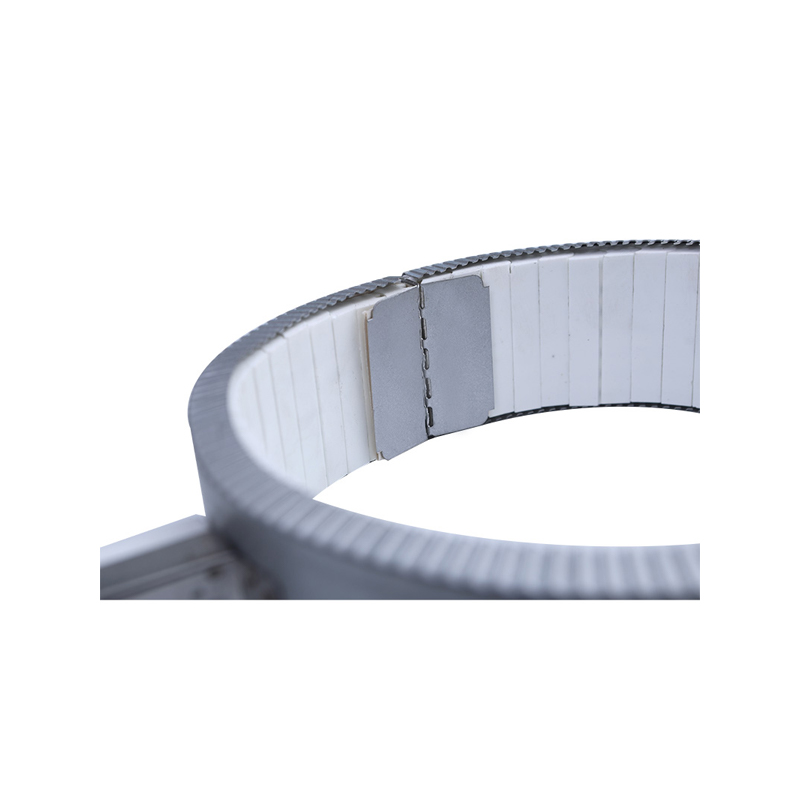 Ceramic Band Heater with Stainless Steel Shell for High-Temperature ProcessesThis heater uses ceramic-insulated elements rated for continuous operation up to 648°C, suitable when process temperatures exceed 400°C or watt density exceeds 30 W/in². Its rapid heating and even distribution support demanding applications.View Product →
Mica band heaters are the economical default below roughly 400°C and 30 W/in², but a ceramic band heater is the correct specification whenever the process runs past either limit.
The insulation decides both limits. Mica is a natural sheet mineral that delaminates and loses dielectric strength when held above 450°C or driven hard for long cycles. Ceramic segments are compacted and fired, so they tolerate the same electrical load with internal temperatures still inside their rating.
| Parameter | Ceramic band heater | Mica band heater |
| Maximum continuous temperature | 648°C (1200°F) | 450°C (840°F) |
| Practical watt density | 40 to 100 W/in² | 15 to 40 W/in² |
| Insulation material | High-purity ceramic segments | Natural mica sheet |
| Moisture resistance | Moderate, improves with sealed leads | Lower, mica can delaminate |
| Relative cost per unit | Higher | Lower |
This does not mean ceramic is always the better buy. Where barrel temperature stays below 350°C and the heater is removed frequently during product changes, mica construction is simpler, lighter, and cheaper.
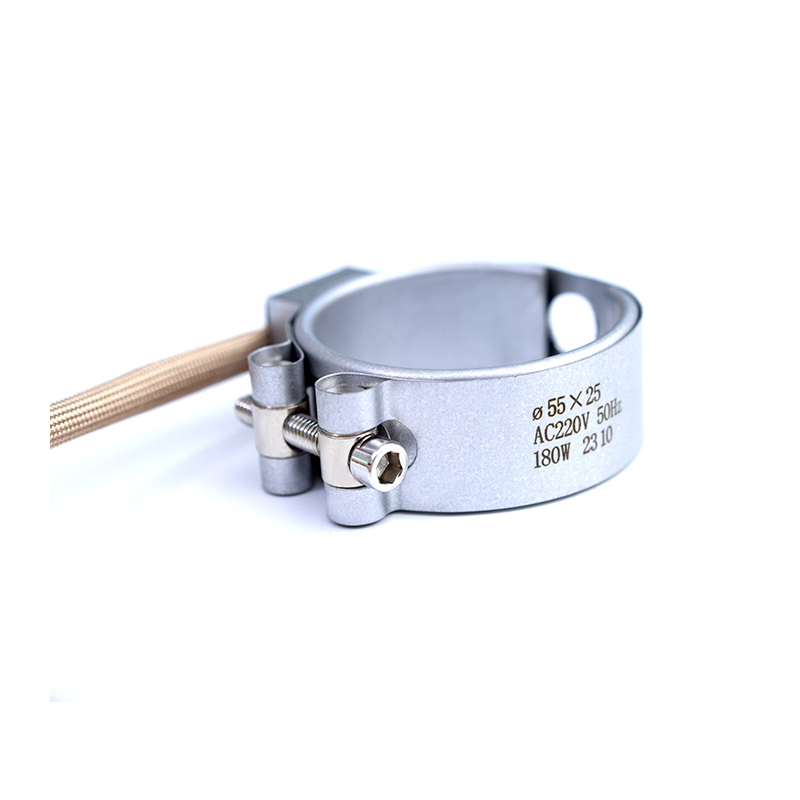 Mica Band Heater with NiCr Wire for Lower-Temperature Frequent CyclingThis economical mica heater suits barrel temperatures below 350°C and frequent removal during product changes. It offers reliable, lightweight performance for injection molding and extrusion blow molding machines.View Product →
Watt density, calculated as installed wattage divided by the heated surface area, is the single most reliable predictor of band heater service life.
On a 90 mm barrel with a 60 mm wide heater, the heated area is about 26 in². A 1500 W zone therefore runs at roughly 57 W/in², a load that is normal for ceramic insulation and structurally unsafe for mica during sustained full-power cycling. The first zones after the feed throat are the worst case: the polymer is cold, the controller demands full power, and the element sits at its hottest internal temperature at the same moment.
Five parameters define a correct ceramic band heater order: barrel diameter, heater width, lead exit, voltage, and thermocouple clearance.
Factories that build custom ceramic band heaters, including Yading (Xinghua Yading Electric Heating Element Co., Ltd.) with an annual output above 500,000 heating elements, normally ask for all five parameters in the inquiry. If the zone layout is unusual, send the barrel drawing and zone wattage list to the manufacturer before ordering.
Extrusion, injection molding, blow molding, and hot runner systems specify ceramic band heaters when zone temperatures exceed 350°C or when uptime targets reject mid-campaign heater swaps.
PET preform molding is the clearest example. Barrel setpoints land between 270°C and 290°C, which mica can reach, but high screw speeds add shear heat that pushes real conditions up against the mica ceiling. Continuous preform lines routinely move those zones to ceramic insulation to reach rebuild intervals of one to two years instead of several months.
Nozzle and hot runner manifold heaters also rely on ceramic insulation, because the small available surface forces watt density above what mica can carry.
A ceramic band heater with a stainless steel sheath is rated for continuous operation at 648°C (1200°F). Short excursions can go higher depending on the sheath alloy and termination, but continuous duty should stay at or below that figure.
Compare the actual barrel temperature and the calculated watt density against the limits in the table above. If either exceeds 400°C or 30 W/in² for sustained periods, specify ceramic. Below those levels, mica is cheaper and easier to handle.
Yes. Nozzle and hot runner zones are among the most common ceramic applications because the small surface area forces watt densities that mica cannot sustain.
Service life depends on duty cycle, clamp condition, and whether watt density is within the rating. In high-temperature extrusion zones, a correctly sized ceramic band heater typically outlasts a mica unit by two to three times.
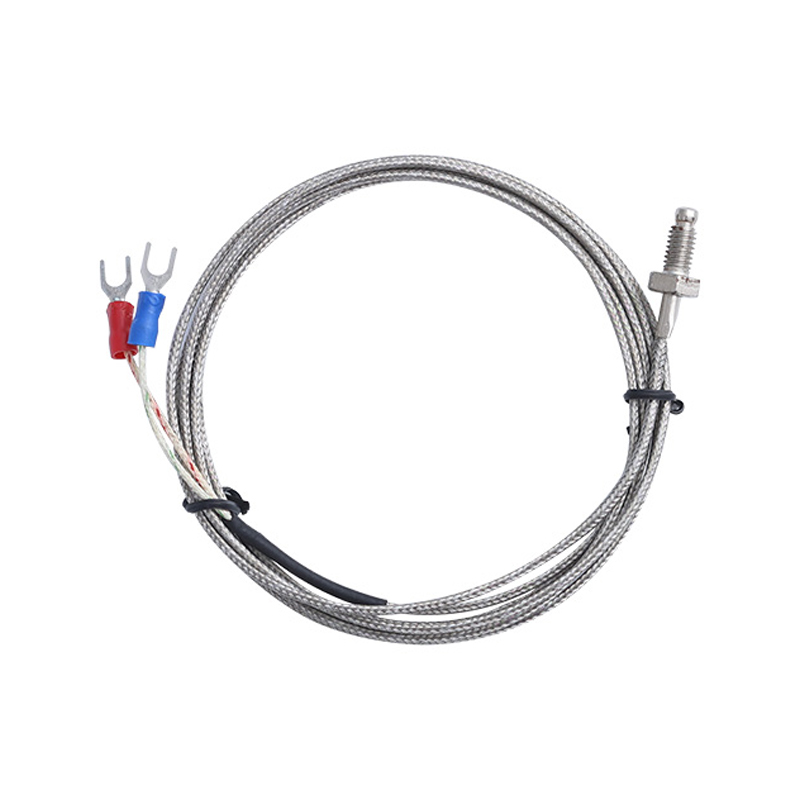
Type B Thermocouple: High-Temperature Range, Accuracy, and Selection Guide
Sep 09,2026
No previous article
Jan 01,1970Your email address will not be published. Required fields are marked *